
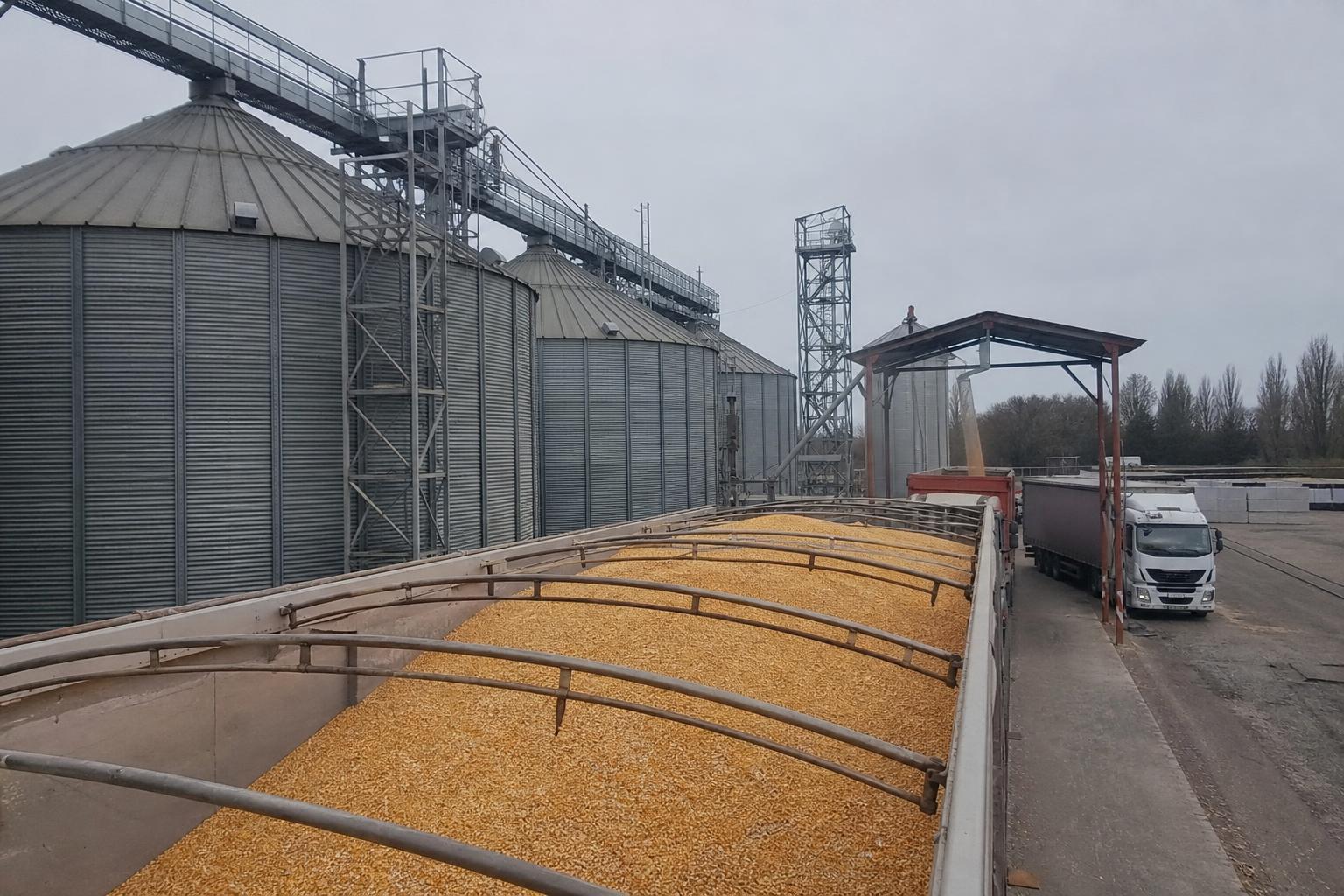
Ukraine’s grain market could enter the 2026/2027 marketing year with significantly higher carryover stocks. According to the Ukrainian Agrarian Confederation (UCAB), they could reach 32.7 million tonnes, while exports of the three main grain crops are expected to total 20.2 million tonnes.
For the transport and logistics sector, this is not a firm forecast of freight rates or route utilisation, but a reason to assess more accurately the need for grain transportation and storage throughout the season.
Export outlook falls short of market requirements
UCAB estimates production of wheat, corn and barley at 59.2 million tonnes in the 2026/2027 marketing year, with domestic consumption at 16.9 million tonnes. At these levels, at least 42.5 million tonnes would need to be exported annually to prevent stocks from continuing to accumulate.
The projected exports of 20.2 million tonnes are well below this benchmark. Supply chain participants should therefore factor in the risk that some of the harvest will remain in storage for an extended period, without treating these estimates as confirmed volumes of actual shipments.
Corn to account for the largest share of carryover stocks
According to the forecast, ending corn stocks could rise to 19.2 million tonnes, up from 5.7 million tonnes a season earlier. Corn exports are estimated at 6 million tonnes, compared with 21.3 million tonnes in the previous marketing year.
Corn could account for almost 59% of the total carryover stocks of the three grain crops. For sellers and buyers, this is a reason to agree in advance on transport schedules, shipment sizes and storage terms, taking into account the specific route and available capacity.
Transport planning will require flexibility
According to UCAB’s calculations, if annual exports reach 42.5 million tonnes, stocks could remain at 32.6 million tonnes at the end of the 2029/2030 marketing year. With exports of 37 million tonnes, they could rise to 49.1 million tonnes, while exports of 50 million tonnes could bring them down to 10.1 million tonnes.
These scenarios show how strongly the stock balance depends on export volumes. Carriers and traders should monitor the actual pace of exports and revise shipment plans as new data becomes available. The forecast alone does not justify conclusions about specific changes in freight rates or utilisation on individual routes.
What this means for the market
If UCAB’s estimate proves accurate, logistics companies, grain sellers and buyers will have to plan operations amid substantial stocks and uncertainty over the pace of exports. The practical priority is to check transport schedules, storage availability and shipment specifications in advance, and to make decisions on transport volumes based on actual contracts and available capacity.
Comments
No comments yetNo comments yet - be the first.