
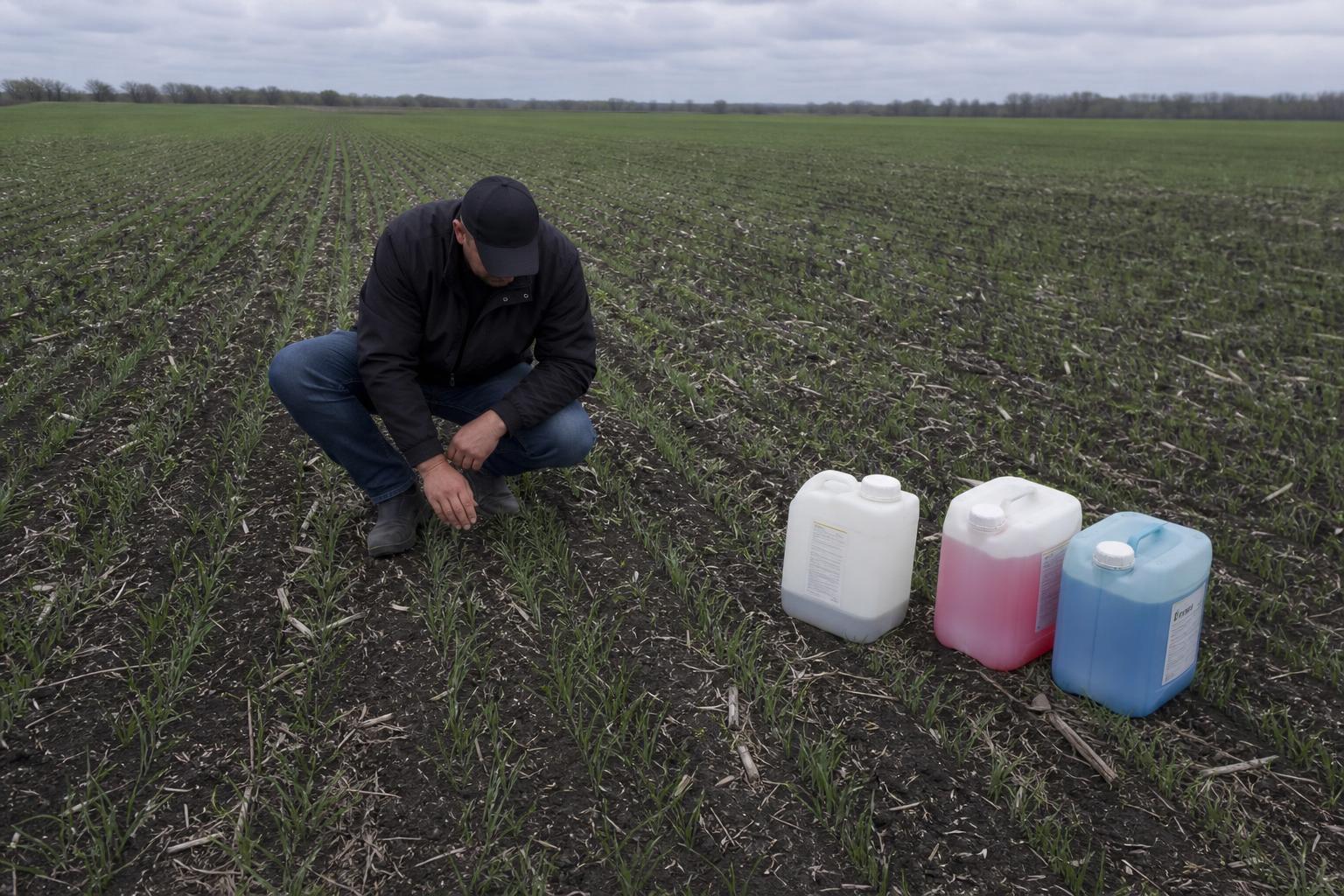
Autumn sowing of winter cereals traditionally creates a separate demand wave for fertilizers. This season, farmers’ attention is focused not only on basic nutrition but also on starter NPK formulas, micronutrients, and products for seed pre-treatment.
For AgroPost sellers, this signals the need to prepare offers tailored to specific farm tasks: rapid winter crop emergence, uniform germination, root system development, and increased plant resilience to autumn stresses.
What Buyers Look for Before Sowing Winter Crops
The demand is centered on liquid complex fertilizers containing phosphorus and potassium, applied during sowing in the seedbed or beside the seed. According to Ukravit experts, formulas such as NPK 5-20-5, 8-24, or 3-18-18 can be used for winter wheat and barley at rates of 20–50 L/ha.
The practical value of these products for farmers is to ensure accessible nutrition for plants at the start, when the root system is still developing. This initial period often determines sowing uniformity and overwintering potential.
Micronutrients and Amino Acids as Part of the Technology
A separate market segment includes products for seed pre-treatment. Recommendations for winter cereals emphasize easily assimilable L-amino acids, zinc, manganese, and copper.
According to the manufacturer, such treatments can increase field seed germination by 8–10% and sprouting energy by 5–6%. They also influence germination uniformity and root development.
This means that buyers increasingly seek not just a single container of fertilizer but ready-made technological combinations: micronutrients, amino acids, or humates, depending on soil type and seed condition.
How Sellers Should Structure Offers on AgroPost
Fertilizer suppliers should organize their listings not only by product name but also by usage scenario. The most effective proposals clearly specify the crop, application stage, fertilizer form, application rate, and compatibility with seed treatments or other tank-mix components.
- For starter application: liquid NPK with high phosphorus and potassium content.
- For seed treatment: micronutrients, amino acids, humates, or stimulating components.
- For early sowings: foliar feeding at the 3–4 leaf stage.
- For light and podzol soils: solutions with humates or adapted starter complexes.
Farmers often have limited time before sowing to make decisions. Therefore, listings with specifics regarding purpose, packaging, stock availability, and delivery across Ukraine will have an advantage over general descriptions.
Foliar Feeding: Demand After Emergence
For early sowing crops at the 3–4 leaf stage, experts recommend foliar feeding of cereals. The recommendations include complex fertilizers for cereals at 1.5 L/ha or potassium NPK solutions at 1.0 L/ha.
The goal of such feeding is to supply plants with macro-, meso-, and microelements, support sugar accumulation, and increase winter crops’ resilience to stress conditions and low temperatures.
Key takeaway for sellers: seasonal demand does not end at sowing. After emergence, farms may order additional foliar fertilizers, potassium formulas, and anti-stress products if they observe uneven development or weather-related risks.
Implications for the Market: In the winter cereal fertilizer segment, demand shifts from basic nutrition to comprehensive technological solutions. On AgroPost, sellers should highlight starter NPK, micronutrients, amino acids, humates, and foliar feeding as separate clear offers, while buyers should compare products not only by price but also by application stage, application rate, and soil type compatibility.
Comments
No comments yetNo comments yet - be the first.