
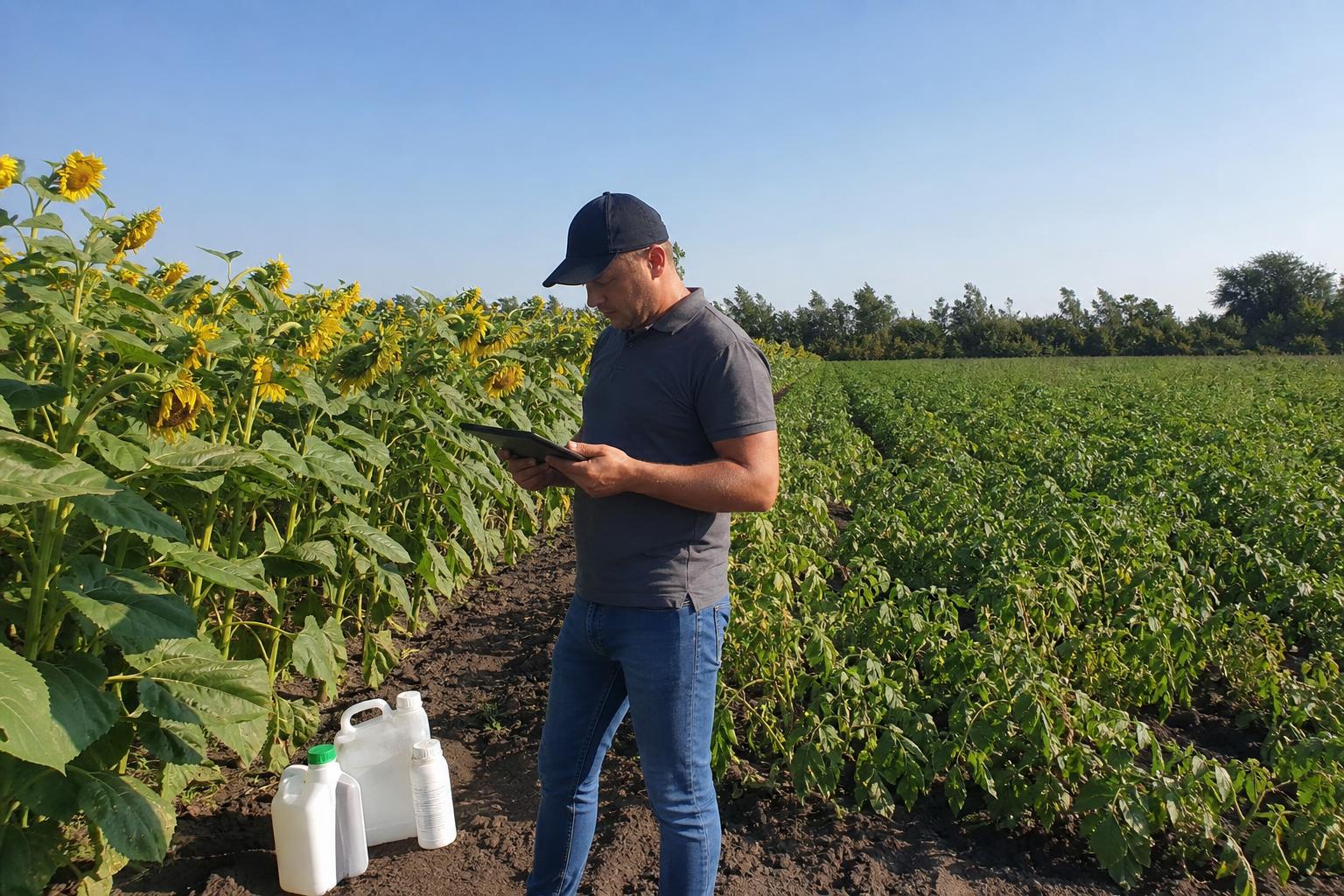
Ukrainian producers are entering a new season phase with noticeable pressure on margins. In potato farming, some farmers in Chernihiv region are reducing areas due to high costs, while the oilseed market is experiencing a decline in sunflower and sunflower oil prices.
For the plant protection segment, this is an important signal: demand for crop protection products (CPP) remains, but buyers will evaluate price, application rates, stock levels, and the projected economic effect of each treatment more carefully.
Product prices are prompting more detailed technology calculations
In the Kulykiv region of Chernihiv oblast, farmers are decreasing potato planting areas as the crop becomes less profitable amid rising costs. Harvesting with a tractor is estimated at 100–190 UAH per hundredweight depending on the locality.
Including plowing, planting, treatment, and harvesting, total expenses for 10 acres can amount to at least 4,000 UAH. Meanwhile, potatoes can be purchased on the market at approximately 8–12 UAH/kg wholesale and 15–20 UAH/kg retail.
For CPP sellers in this segment, it is important to discuss not only the product but also the economics of the scheme: how much the treatment protects marketable produce, whether it reduces quality losses, and if it matches the farm’s scale.
Oilseed crops also lead to more cautious procurement
Last week, sunflower market offers for the new harvest increased. Processors lowered purchase prices by another 500–1000 UAH/t — down to 19–20.5 thousand UAH/t FOB.
In southern regions, prices remain higher due to competition for raw material: processors and exporters offered 21–21.5 thousand UAH/t FOB. In ports and towards the western border, prices remained almost unchanged at 21–22 thousand UAH/t DAP.
Additional pressure comes from the sunflower oil market. Over the past two weeks, the price of Ukrainian oil on FOB terms decreased by $150/t, while in destination markets, the decline was smaller — approximately $50–60/t. The current valuation of Ukrainian sunflower oil on FOB is around $1140/t.
Under these conditions, sunflower producers may delay some expenses or review their protection budgets. However, abandoning critical herbicide or fungicide solutions can be risky if the field has high yield potential or strong weed and disease pressure.
What CPP buyers will look for on AgroPost
- Transparent price per hectare. Buyers need to see not only the cost of a canister but also the actual treatment cost.
- Availability and quick delivery. During seasonal operations, delays can cost more than the price difference.
- Confirmed origin. Amid cost-saving measures, the risk of purchasing dubious products increases, making documentation and seller reputation important.
- Alternatives by active ingredient. Buyers will compare herbicides, fungicides, and insecticides based on composition, application rates, and usage regulations more frequently.
- Solutions tailored to specific crops. Offers for potatoes, sunflower, cereals, or rapeseed are more effective than general ads without technological context.
How CPP sellers can adapt their proposals
During periods of low margins, farmers do not always buy the cheapest options. They more often seek predictable results: weed control, protection of the leaf apparatus, preservation of quality, and minimizing re-treatment risks.
Sellers should clearly specify the crop, application stage, active substance, packaging, stock availability, and shipping conditions. For small and medium producers, offering convenient batch sizes is also important, not just large wholesale volumes.
For buyers, a practical approach is to develop a list of mandatory treatments and separately highlight options that can be replaced with analogs. This helps maintain the technology while avoiding overpayment where equivalent alternatives exist.
What this means for the market
The plant protection market in Ukraine is shifting towards more pragmatic procurement. Price pressures in potato and oilseed crops are prompting farmers to more carefully evaluate CPP efficiency, while sellers need to make clear, verified, and practically applicable offers linked to real field tasks.
Comments
No comments yetNo comments yet - be the first.