
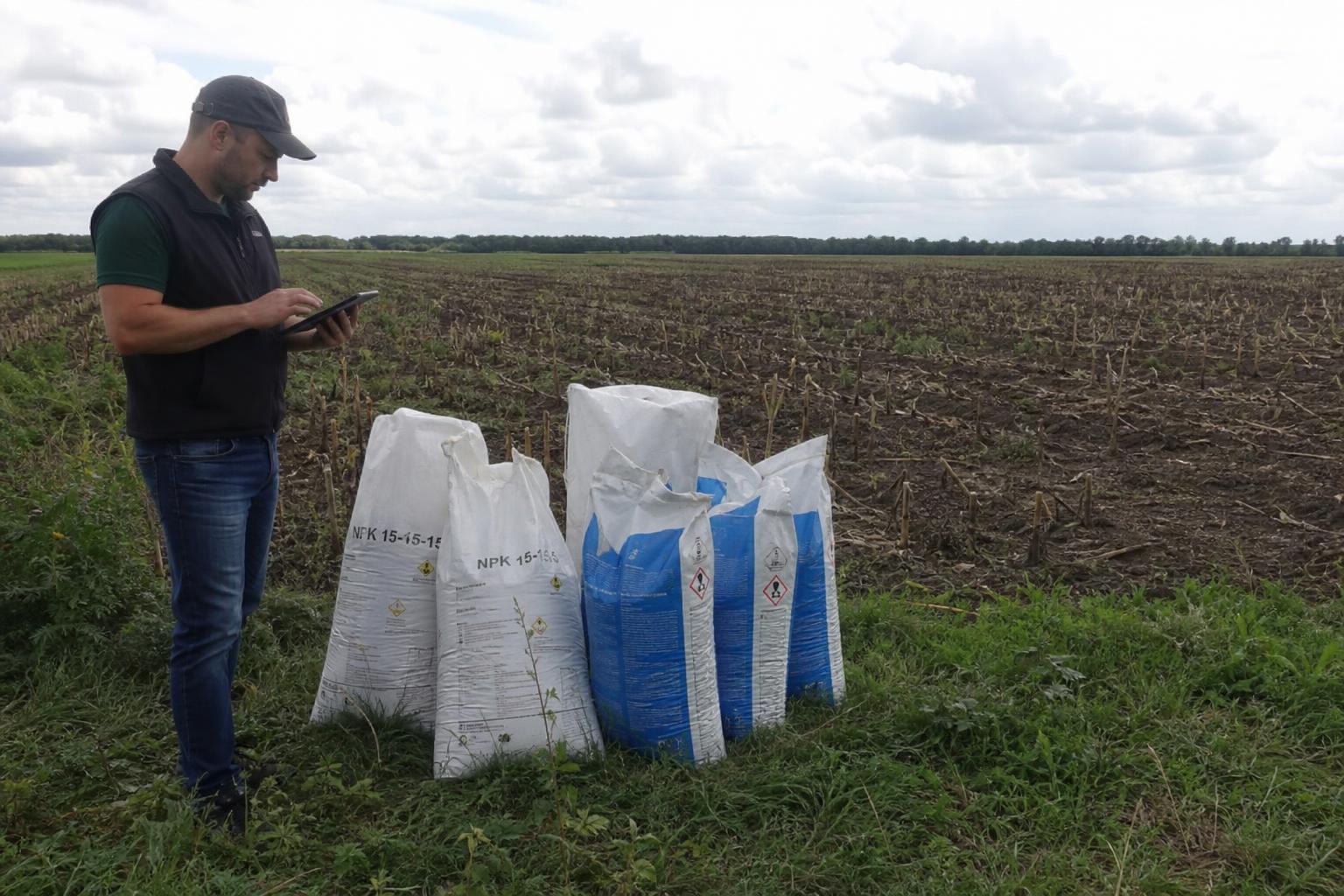
The Ukrainian fertilizer market is entering a period when farmers are increasingly paying attention not only to the cost per ton but also to the economics of application for specific crops. This is especially relevant for farms cultivating sunflower, soybean, and cereals in rotation.
Current field data from Cherkasy region indicate that sunflower and soybean at the start of harvest are demonstrating higher yields than on the same date last year. For fertilizer suppliers, this provides an argument to prepare offers not just "generally for the sowing season," but tailored to specific feeding schemes and crop needs.
What the field data show
In Cherkasy region, cereals and legumes have been harvested on an area of 285.7 thousand hectares. A total of 1,484.8 thousand tons of grain have been harvested with an average yield of 52 c/ha. On the same date last year, the figure was 55.6 c/ha.
Sunflower has been harvested on 15.2 thousand hectares, or 5.6% of the total harvest area. The yield amounted to 36.1 thousand tons with an average of 23.8 c/ha compared to 23.5 c/ha last year.
Soybean has been harvested on 12.9 thousand hectares, representing 19.9% of the planned area. A total of 20 thousand tons have been harvested with a yield of 15.5 c/ha. Last year, on this date, the yield was 14.4 c/ha.
Why this is important for the fertilizer segment
For the fertilizer market, such data are valuable not as demand forecasts but as practical benchmarks for planning the next cycle. If a farm observes results for sunflower or soybean, it more frequently revises its nutrient balance: how much elements are removed with the harvest and what needs to be replenished in the soil.
Buyers remain focused on basic products for field crops: nitrogen fertilizers, NPK complexes, sulfur-containing solutions, starter fertilizers, and microelements. For sellers, it is crucial not just to emphasize price but also to demonstrate application rates, nutrient forms, packaging, delivery conditions, and compatibility with farm technology.
Special attention should be given to soybean. In this crop, farmers often evaluate not only mineral nutrition but also inoculation, phosphorus, sulfur, and microelement availability. Therefore, marketplace offers should be clearly segmented by purpose: for main application, pre-sowing, foliar feeding, or deficit correction.
How fertilizer sellers should prepare offers on AgroPost
Buyers during the season are looking not for vague "cheap NPK," but for a clear product tailored to their task. Therefore, fertilizer ads should stand out through specificity: brand, active ingredient content, form, country or region of shipment, minimum order, documentation, and delivery timeline.
- For NPK it is advisable to specify the ratio of elements and recommended crops.
- For nitrogen fertilizers it is important to indicate the nitrogen form, packaging, and storage conditions.
- For microfertilizers the composition, chelate form, application rate, and application phase should be specified.
- For buyers it is advisable to inquire not only about price but also logistics, quality documents, and the possibility of reserving a batch.
Key conclusions for buyers
The current situation does not allow for predicting sharp price changes for fertilizers without additional market data. At the same time, it emphasizes that procurement decisions should be linked to sowing structure and actual harvest results.
- After harvesting oilseeds and soybean, it is advisable to update the nutrient balance for fields.
- Complex fertilizers should be selected based on crop, soil, and planned technology.
- Offers should be compared based on the cost of active ingredients, not just price per ton.
- For early reservation of batches, it is important to verify availability, documents, and actual delivery times.
What this means for the market: the fertilizer segment in Ukraine is moving toward more application-oriented demand. Sellers should tailor offers to specific crops and regions, while buyers should use harvest results as a basis for more precise planning of NPK, nitrogen nutrition, and corrective fertilization for the next season.
Comments
No comments yetNo comments yet - be the first.