
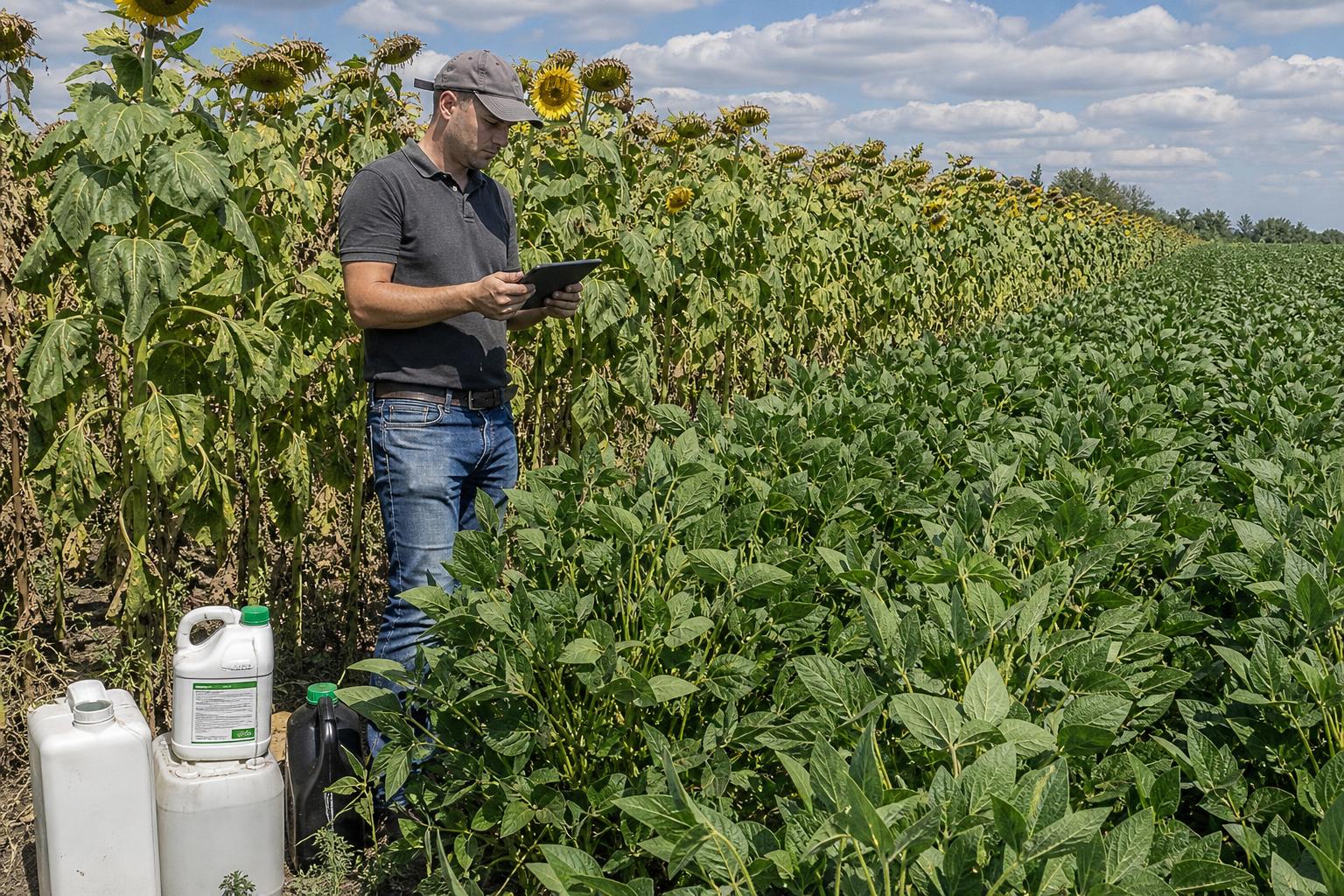
The plant protection market in Ukraine is increasingly influenced not only by phytosanitary conditions in the field but also by the economics of the crops. For sellers and buyers of crop protection products, oilseeds — primarily sunflower and soybean — are becoming key reference points.
In the 2026/27 season, a significant increase in sunflower production is expected; however, sales and processing remain under logistical pressure. This means farmers may adopt a more cautious approach to budget planning for crop protection, favoring solutions with clearly demonstrated return on investment.
Sunflower: Increased Production Means Higher Expectations for Protection Economics
According to APK-Inform, the sunflower harvest in Ukraine in 2026 could reach 13.5–13.6 million tons, representing a 26% increase compared to 2025. The theoretical processing capacity for the 2026/27 season is estimated at 13–13.3 million tons.
At the same time, analysts note subdued demand from processors, daily downward price revisions, and a slow start to processing. This serves as an important signal for farms: even with high production potential, expenses on technology, including herbicides and fungicides, should be aligned with the actual sales scenario of the harvest.
Practically, this could strengthen demand not for the cheapest options but for those with predictable outcomes based on protection schemes. Crop protection buyers will seek products that help reduce the risk of yield and quality loss but without unjustified budget expansion.
Logistics Influence Crop Protection Decisions
Sources indicate that the operation of deepwater ports remains limited, alternative routes are congested, and a shortage of land transport affects the export of processed products and sector profitability. While not directly an agronomic factor, this impacts the financial behavior of producers.
If a farm has advantageous logistics and better access to sales channels, it can more actively invest in comprehensive protection technology. For remote regions, decisions may be more conservative: priority will be given to basic herbicide programs, control of critical diseases, and targeted fungicide treatments as needed.
For sellers on AgroPost, this means clearly demonstrating which crops, growth stages, and typical problems a product addresses. The clearer the link to field tasks, the easier it is for the buyer to assess the cost-effectiveness of the purchase.
Soybean: Export Opportunities Support Interest in Quality Technologies
Ukrainian soybean, according to market participants, could serve as an alternative resource for Turkey and Mediterranean countries when Brazil or the USA do not meet demand. However, key risks for Ukrainian exports remain logistics and security issues.
For the crop protection market, this creates a mixed signal. On one hand, the potential demand from importers supports interest in soybean cultivation. On the other hand, uncertainties regarding delivery and pricing compel producers to carefully evaluate each treatment.
In the soybean segment, buyers may be more interested in herbicides for early weed control and fungicide solutions if weather conditions and crop status pose disease risks. However, the specific scheme should depend on the region, previous crop, field contamination, and hybrid or variety.
What Sellers and Buyers of Crop Protection Products Should Consider on AgroPost
- Buyers: plan oilseed protection not only by calendar but also based on crop economics and actual sales channels.
- Sellers: clearly specify crop, spectrum of action, application stage, and usage restrictions in product listings.
- For sunflower: demand may focus on solutions that help maintain yield amid volatile selling prices.
- For soybean: offer technologically understandable solutions, as the export potential depends on quality and supply stability.
- For regions with more complex logistics: interest in optimized schemes with minimal treatments is likely to grow.
What this means for the market. The crop protection segment in Ukraine remains tied to oilseed crops, but demand is becoming more rational. Farmers will seek not just products but solutions with predictable returns, while sellers need to communicate the practical benefits of their products for specific crops and field situations.
Comments
No comments yetNo comments yet - be the first.