
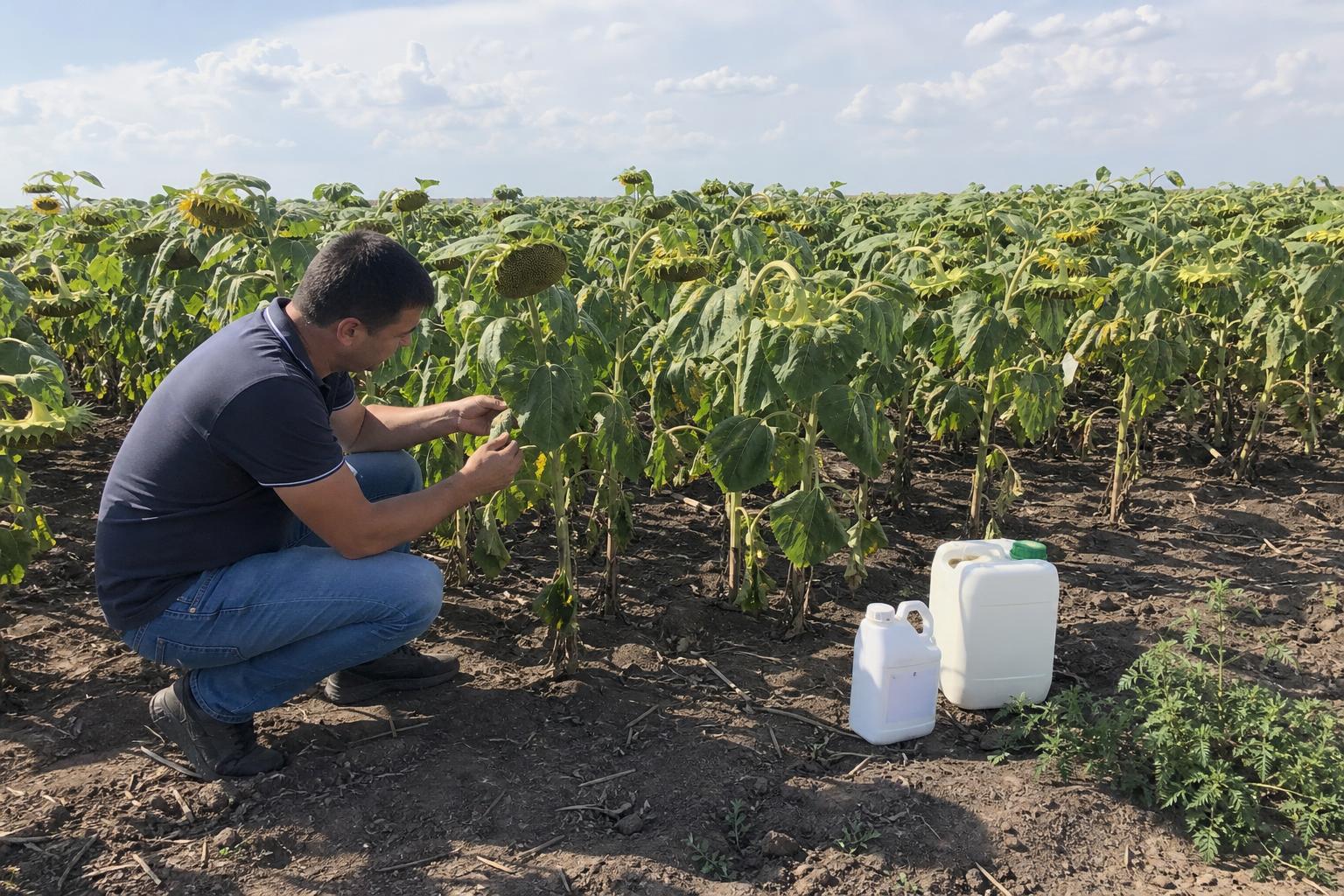
In the plant protection market, sunflower remains the focus: this crop accounts for a significant share of demand for fungicides, herbicides, and related services. This year, some producers note a calmer situation regarding diseases, particularly with no substantial sclerotinia infection.
For suppliers and buyers of plant protection products, this does not mean a pause in procurement. On the contrary, agricultural producers are paying closer attention to the economics of treatments, seed quality at elevators, and compliance with future regulatory requirements.
Sunflower: quality of batches supports cautious optimism
Vitagro reported that this season they have not observed significant sclerotinia infection in sunflower. They also noted that the seed’s acid number remains within normal ranges.
According to the company, last year, issues with sclerotinia and elevated acid numbers were more pronounced. This year, the situation appears more stable: some batches arrive dry, and with moisture around 8.5%, seeds can be conditioned through ventilation without fully running the dryer.
Sunflower oil content at Vitagro mostly exceeds 50%, although on some fields, particularly in Rivne region, lower levels—down to 44%—were recorded. This is important for processors and traders, but for the plant protection segment, the key remains the link between the phytosanitary condition of the field and the subsequent crop quality.
What does this mean for fungicide demand
Lower disease pressure in certain farms cannot be automatically extrapolated to all of Ukraine. Sclerotinia, white rot, and other sunflower diseases depend heavily on region, predecessor crop, plant density, hybrid, weather conditions, and treatment technology.
A practical takeaway for pesticide buyers: fungicide purchases should be planned based on risk assessment for each field, not just by inertia. For sellers, this presents an opportunity to offer not only products but also advice on application timing, prevention, and tank-mix compatibility.
- For farms: record disease history and compare it with harvest quality at reception.
- For distributors: focus on preventive solutions rather than only curative schemes.
- For elevators and processors: quality indicators of batches can serve as additional arguments in discussions with producers regarding protection strategies.
Herbicides and fungicides: moving towards more precise selection
In plant protection, the emphasis is increasingly on the justification of treatments rather than their quantity. If a field does not have a high infection background, producers may revise their schemes, but complete abandonment of monitoring is risky.
This is also relevant for the herbicide segment: a clean field reduces competition for moisture and nutrients, helping the crop realize its potential. In sunflower, a high-quality seedling start directly influences the plant’s resilience to stress later on.
For AgroPost pesticide sellers, it is advisable to clearly describe the crop, spectrum of activity, active ingredient, application phase, and restrictions. Buyers should request quality certificates, verify residues, production date, and recommendations tailored to their technology.
Regulatory environment: EU standards remain a factor for pesticides
The Ukrainian agro-sector is preparing for gradual alignment with EU requirements in production, ecology, and food safety. UACAB emphasizes that such adaptation will require significant investments and should be accompanied by clear access conditions to the European market.
For the pesticide market, this means that questions of legality, traceability, and compliance with regulations will remain important. Even if specific transitional rules are still being finalized, buyers are already paying closer attention to product origin and risks for future crop sales.
Implications for the market: this year's signals of reduced sclerotinia infection in some farms support demand for precise, economically justified protection schemes. For pesticide sellers, the focus shifts from the broadest range to quality consultation and transparent product characteristics; for buyers, timely field monitoring and procurement of products with verified origin are crucial.
Comments
No comments yetNo comments yet - be the first.