
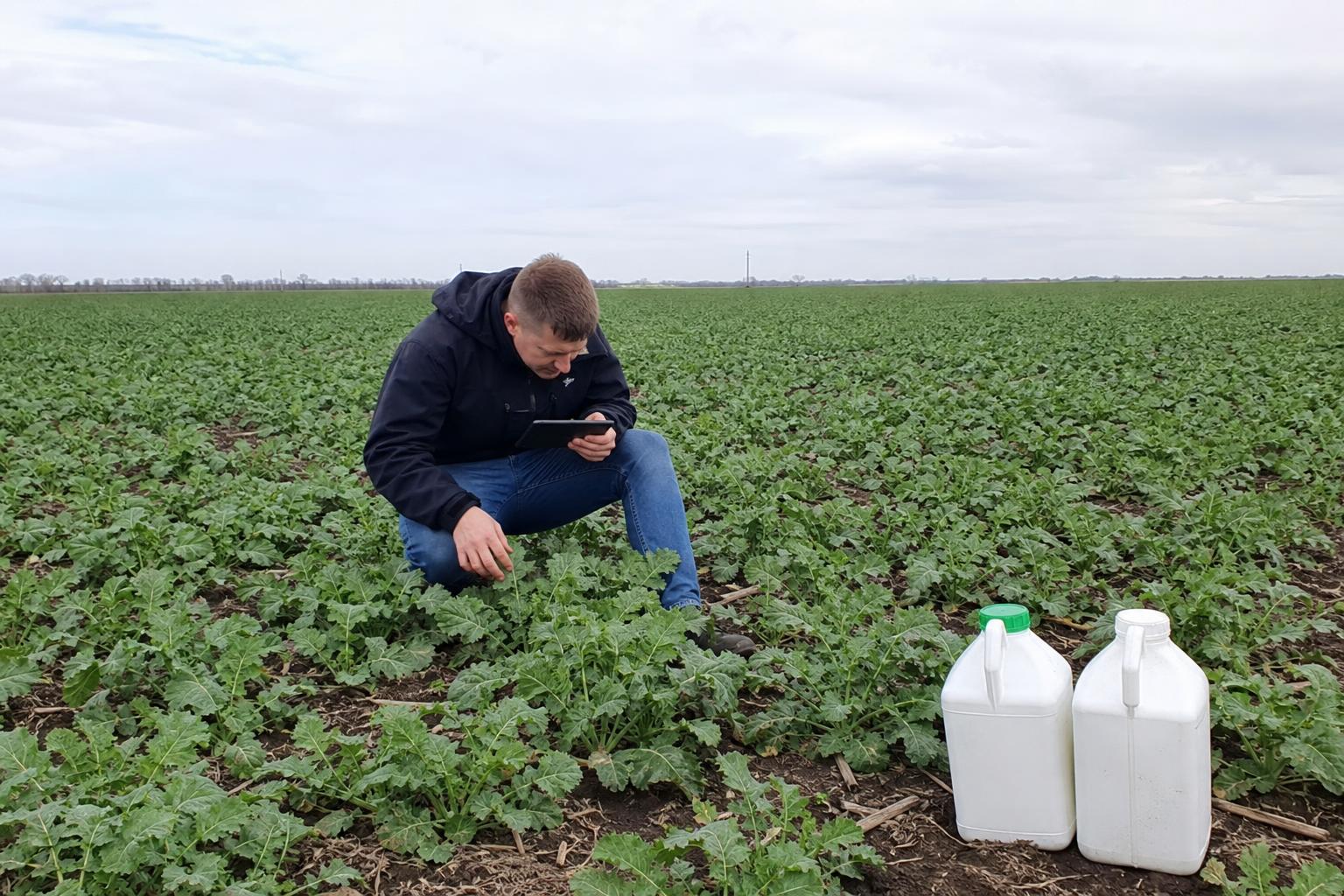
The Ukrainian rapeseed market is entering a period when crop protection decisions need to be more closely tied to the economics of the crop. According to recent industry data, procurement prices for rapeseed in Ukraine have decreased, and external market pressures are also affecting quotations.
For the crop protection segment, this does not mean demand will stop. However, buyers are becoming more attentive to the cost per hectare, payment terms, documentation availability, and clear positioning of products for specific growth stages of the crop.
Rapeseed remains an important crop, but margins are under control
Last week, prices on the Ukrainian rapeseed market declined. In ports, hryvnia prices mostly ranged from 22.1 to 23.3 thousand UAH/ton on CPT terms.
Analysts estimate that processors have reduced activity in rapeseed procurement due to better margins on sunflower processing. Purchase prices on CPT factory terms decreased by approximately 200 UAH/ton.
On the external market, there was also a weakening. According to Spike Brokers, November futures for rapeseed on MATIF decreased to €536.75/ton over the week, and February futures fell to €555.25/ton.
Indicative prices in Ukraine also declined: $500/ton CPT port, $550/ton FCA Chop, and $470/ton CPT plant. For farmers, this signals the need to carefully account for each technological operation, including expenses on herbicides, fungicides, and other crop protection products.
Export structure is changing: more processed products
In the first 13 weeks of the 2026/27 MY, Ukraine reduced rapeseed exports to the EU by 44% — to 336.05 thousand tons compared to 599.9 thousand tons in the same period of the previous season.
At the same time, Ukraine remains the largest supplier of rapeseed to the EU. Its share in EU rapeseed imports decreased from 59.21% to 38.56%, but it still remains a leading supplier.
Significantly stronger dynamics are observed in processed products. Ukrainian rapeseed oil supplies to the EU increased 2.2 times — to 96.82 thousand tons, and Ukraine’s share in European imports of this product rose to 75.61%.
Exports of rapeseed meal from Ukraine to the EU increased by 87.1% — to 63.65 thousand tons. This supports interest in the crop but does not eliminate the need for precise cost calculations.
What crop protection buyers should consider
During periods of price pressure, farmers more frequently review technological plans. The most practical approach is not to abandon protection but to verify which operations truly impact yield potential.
- Compare not only the canister price but also the cost per hectare. This helps accurately assess proposals for herbicides, fungicides, and auxiliary products.
- Clarify active ingredient, concentration, and registration. In the crop protection category, saving on unverified products can pose greater risks than differences in purchase price.
- Plan purchases according to crop development stages. It is advisable to separately cover needs for autumn weed control, fungicide protection, and spring continuation of the scheme.
- Arrange logistics and delivery terms in advance. Especially if the product is needed within a narrow technological window.
What ZAP (crop protection products) sellers should focus on on AgroPost
For crop protection product sellers, the current market is a time for clear commercial offers rather than aggressive promises. Buyers need transparent pricing, availability, packaging, documentation, and quick responses.
In advertisements, it is important to specify the crop application, active substance, product form, packaging, minimum order quantity, payment conditions, and shipment region. This reduces inquiries and speeds up transactions.
If the product is positioned for rapeseed, it is better not to limit to a general phrase like “for oilseeds.” Instead, specify at which stage of the technology it can be used, without exaggerated guarantees of results.
What this means for the market. Rapeseed remains a crop with active export and processing directions, but weaker prices are forcing farmers to more carefully calculate expenses. In the crop protection market, this increases demand for transparent offers, verified products, and protection schemes that can be economically justified for specific farms.
Comments
No comments yetNo comments yet - be the first.