
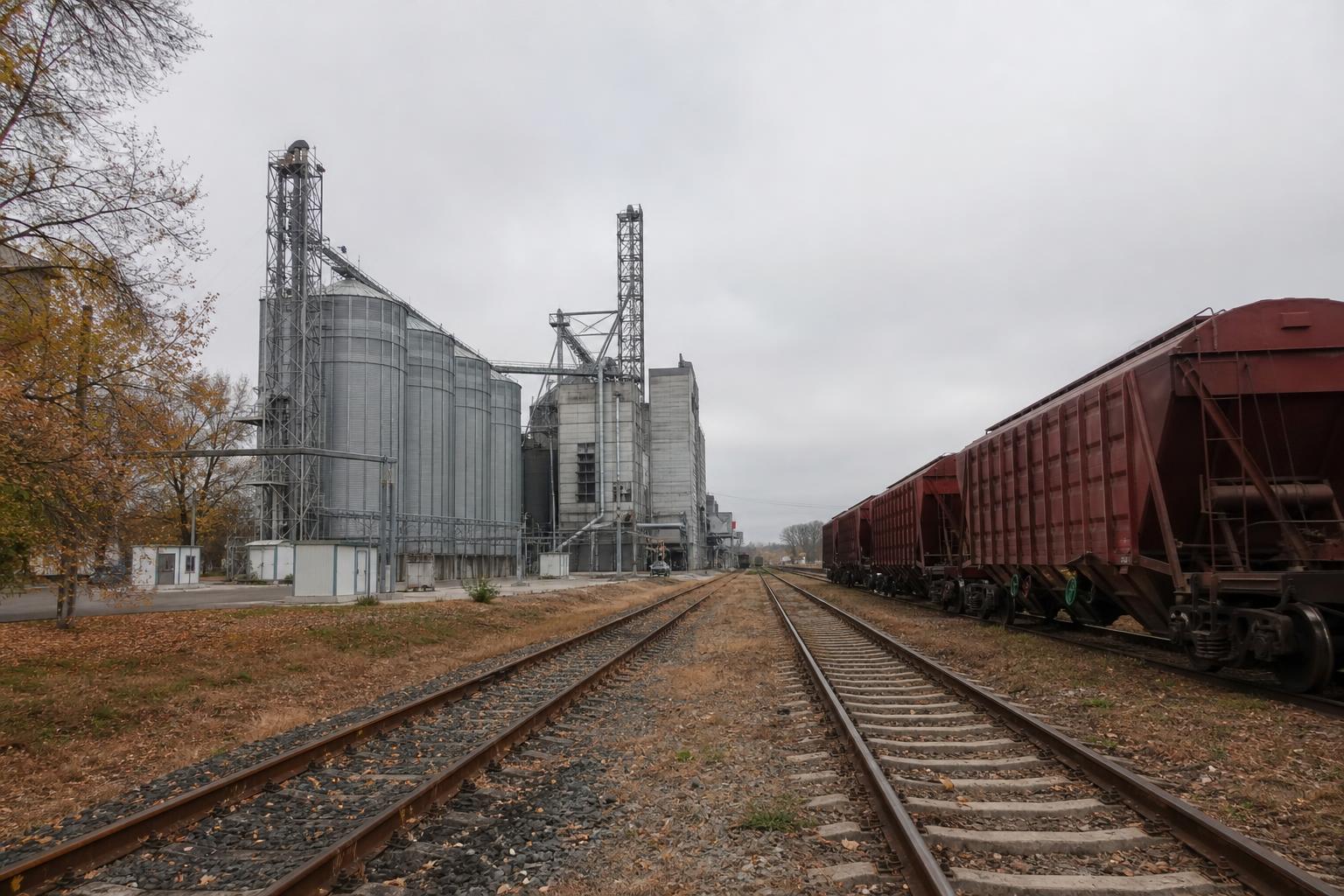
At the beginning of October, railway grain exports through Ukraine's western border significantly intensified. According to data presented at the "Ukrzaliznytsia" meeting with agricultural market participants, the average daily transfer of grain wagons through western crossings increased by 56 units compared to September.
This is an important operational signal for the grain market: demand for western routes remains high, and elevators and sellers should coordinate their shipment schedules not only with buyer prices but also with the actual capacity of the route.
Where the main increase in wagons occurred
The largest number of grain wagons at the start of October was heading to Poland. In the first six days of the month, an average of 106 wagons with grain were transferred daily. This is 37 wagons more than in September.
On the Hungarian route, the daily average increased by 14 wagons to 89.2 wagons per day. The Romanian route also saw growth: an increase of 15 wagons, reaching 72.7 wagons per day.
The only direction with a decline in the data was Slovakia. Grain transfer there decreased by 10 wagons — to 68.5 wagons per day.
What this means for elevators
For elevators in western and central regions, the activation of railway crossings may enhance the role of operational accumulation of export batches. At the same time, differing dynamics across directions indicate that there is no one-size-fits-all logistical solution.
The Polish route currently appears to be the most active in terms of grain wagons transferred. However, this does not eliminate the need to check queues, acceptance requirements, wagon availability, and the elevator's ability to quickly assemble a homogeneous batch.
For companies working with the Romanian route, it is important to monitor further developments in transportation to the Constanța port. Ukraine and Romania agreed to maintain a daily transfer of six train pairs to this port, and to increase to 10 pairs, Romania must accelerate repairs of railway and port infrastructure.
What grain sellers should consider
- The route affects the net price. Even with the same purchase price, differences in logistics can alter the final economics of the deal.
- Poland currently has the highest average daily flow of grain wagons among the listed directions, but this does not guarantee quick passage for each batch.
- Slovakia requires special attention due to the reduction in wagon transfers in early October.
- Elevators should synchronize acceptance, drying, processing, and shipment to avoid internal bottlenecks for export contracts.
- For buyers on AgroPost, it is advisable to clearly specify the desired basis and shipment direction so sellers can more quickly assess the actual margin.
The European factor: access to the market remains an open question
Alongside logistics, Ukraine’s agricultural sector is monitoring the rules of future integration with the EU. UCAAB states that adapting to European standards will require significant investments, and should be accompanied by a clear perspective of full access to the EU market.
For the grain sector, this is not a short-term stock exchange news but a strategic planning risk. If access rules, transitional periods, or protective mechanisms change, traders and producers will need to revise export strategies, quality requirements, and infrastructure investments.
What this means for the market
The growth in grain wagon transfers through western crossings indicates that alternative export logistics remain active but uneven across directions. For grain sellers, the key task is not only to find a buyer but also to pre-calculate the route, timing, elevator readiness, and the actual price after logistical costs.
Comments
No comments yetNo comments yet - be the first.