
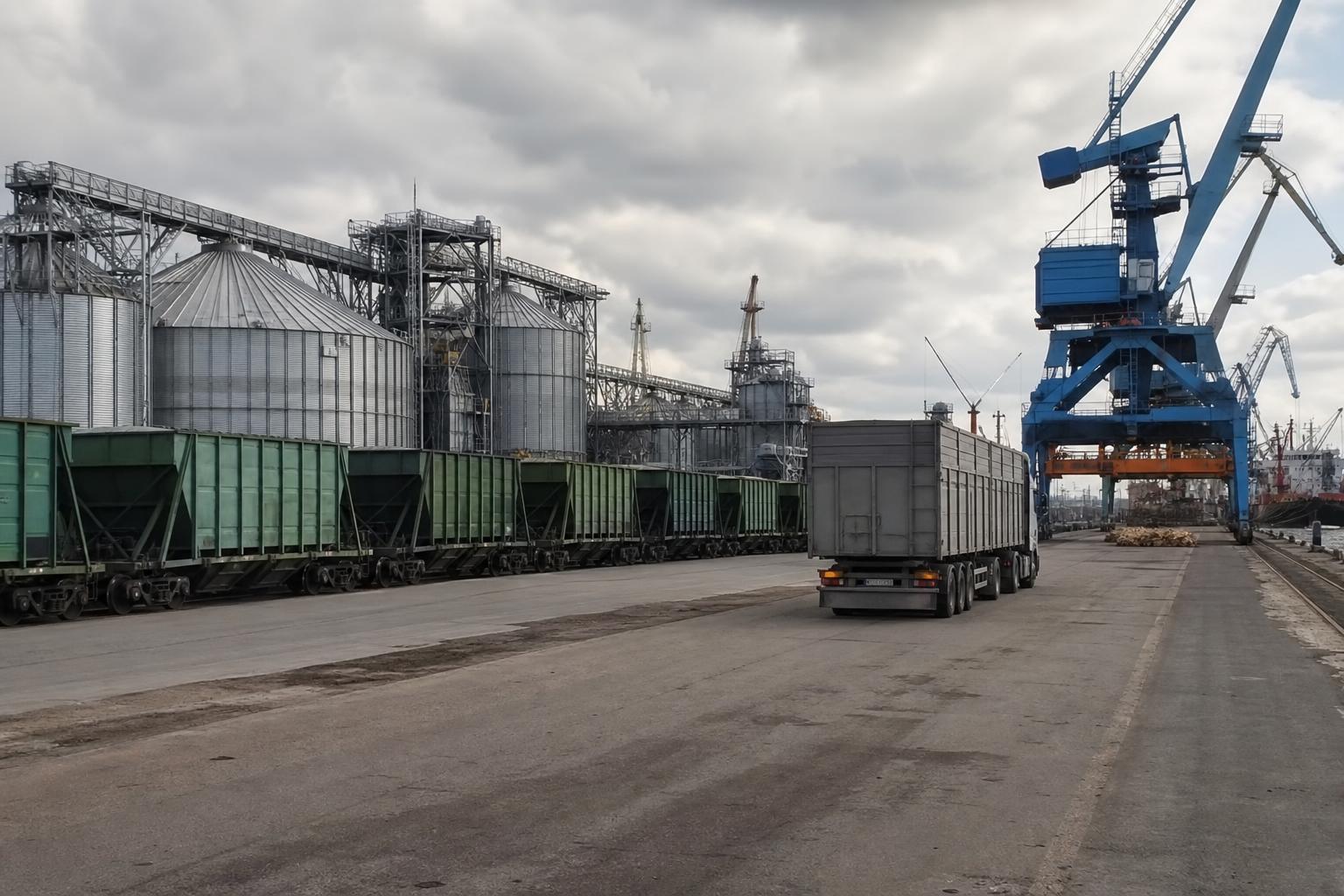
The Ukrainian grain market is entering a new season with a mixed signal: maritime logistics showed growth over the half-year, but security risks in the Black Sea again affect procurement activity and shipment planning.
For grain sellers and elevators, this means that the price of a batch increasingly depends not only on quality and basis but also on the availability of specific routes, traders’ readiness to buy under port conditions, and the speed of reorienting to alternative logistics.
Ports Remain a Key Channel for Agro-Exports
According to the Ukrainian Sea Ports Authority, in the first half of 2026, Ukrainian seaports handled 42.4 million tons of cargo. Of this, 23.6 million tons were agricultural products.
Compared to the same period last year, agro-commodity transshipment increased by 20%. This confirms that the maritime route remains the main channel for large export shipments of grains and oilseeds.
For elevators near railway and port corridors, such dynamics support demand for accumulation, processing, and the prompt formation of export batches. However, the market no longer perceives the port channel as entirely stable: the risk of downtime and changes in procurement conditions persists.
Infrastructure Attacks Increase Contract Risks
The Ukrainian Sea Ports Authority reports that since the full-scale invasion, 1,002 port infrastructure objects have been damaged or partially destroyed, and 221 civilian vessels have been damaged. Additionally, 283 civilians have been affected.
In July, attack intensity increased. In the first two weeks of the month, according to the Ukrainian Sea Ports Authority, 23 strikes on Ukrainian ports and 17 attacks on civilian vessels were recorded. These resulted in casualties among port workers, maritime industry enterprises, and crew members.
Practically, this creates three risks for the grain market: shipment delays, revision of procurement baselines, and a temporary decline in activity among buyers at deepwater ports.
For grain sellers, the main question now is not only “what is the price,” but also “which route is actually operational on the shipment date.”
Danube and River Logistics Remain a Safe Route
Amid uncertainty in the Black Sea, businesses continue to develop alternative transportation solutions. NIBULON has signed a long-term contract with Romanian TTS for international transportation via the Lower Danube between Romania, Serbia, and Bulgaria.
Under the agreement, barge-tug convoys will operate between the three countries over four months. The first voyage has already taken place: vessels delivered phosphate fertilizers from Constanța to Prahovo, and on the return trip, loaded grains and oilseeds in Bulgarian Danube ports for delivery to Constanța.
This circular transportation scheme reduces empty vessel runs. One barge-tug convoy can carry about 8,000 tons of cargo, making this format useful for regular shipments along the Danube route.
Key Takeaways for Sellers and Buyers of Grain
- Ports have increased agro-handling, but current security conditions can quickly change the availability of specific terminals and baselines.
- Elevators should prepare multiple shipment scenarios: deepwater ports, Danube, rail, and combined routes.
- Grain sellers need to secure not only the price but also delivery conditions, shipping schedule, responsibility for downtime, and route flexibility.
- Buyers and traders require flexibility: batches with confirmed quality, proximity to logistics hubs, and transparent documentation will have advantages.
What this means for the market: Ukraine’s grain export capacity maintains strong port potential, but logistical premiums are becoming a key factor in pricing. On AgroPost, sellers should clearly specify crop type, volume, quality, storage location, and possible shipment routes — this increases the chances of quickly finding buyers amid unstable logistics conditions.
Comments
No comments yetNo comments yet - be the first.