
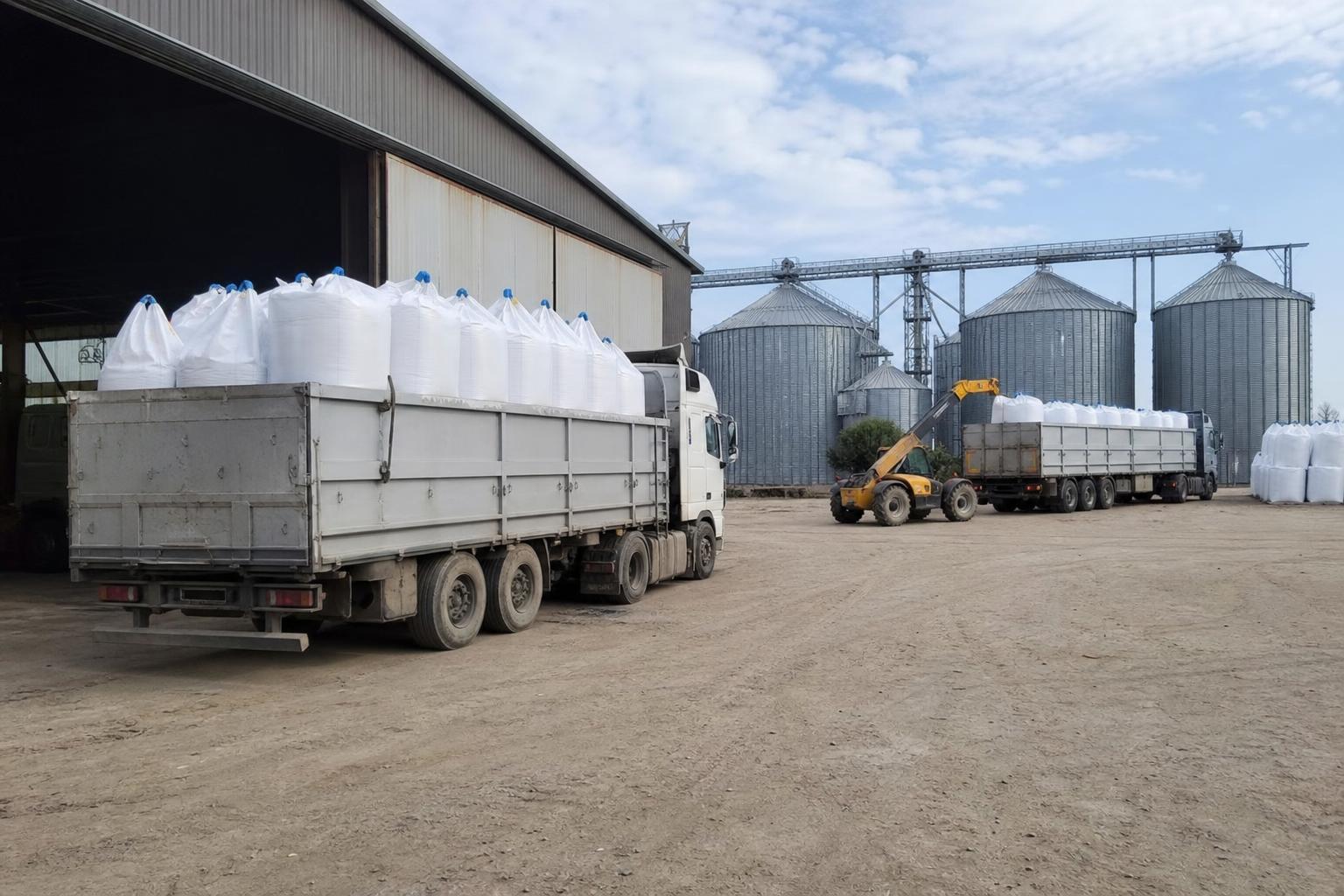
Ukrainian agrologistics is entering a period marked by two simultaneous priorities: timely delivery of production resources for sowing and maintaining margins on grain sales. The most prominent route remains the western border, particularly shipments of mineral fertilizers from Poland.
According to industry media, in 2025 Ukraine imported 784,000 tons of Polish mineral fertilizers, remaining the largest individual buyer of this product. Approximately 25% of Polish fertilizer exports went to the Ukrainian market.
Polish Fertilizers: A Stable Cargo for Western Logistics
Poland continues to be a key source of mineral fertilizers for Ukrainian farmers. This volume of shipments entails consistent loads on border crossings, warehouses, and domestic road logistics.
In the structure of Polish exports, single-component nitrogen fertilizers dominated — 2.29 million tons. Complex mineral fertilizers totaled 655,000 tons. For Ukrainian buyers, this is crucial for planning transportation types, storage conditions, and delivery schedules to farms.
At the same time, Ukraine’s share in Polish exports is gradually decreasing: from 33.8% in 2023 to 25.4% in 2024 and 25% in 2025. This does not indicate a loss of Ukraine’s role as a market but shows that Polish suppliers are expanding their sales geography.
Implications for Carriers and Warehouses
For logistics companies, fertilizers remain a predictable seasonal cargo, but competition for timely deliveries may intensify during peak fieldwork periods. This is especially relevant for routes from the western border to central and southern regions.
Carriers should clearly specify product types, packaging requirements, transportation conditions, and transshipment points in their applications. For warehouses and distributors, key factors include rapid unloading, inventory control, and the ability to assemble smaller batches for farms.
- Fertilizer buyers should book transport in advance, especially during active sowing periods.
- Sellers and traders should offer delivery terms with clearly defined logistics components.
- Carriers should highlight services for mineral fertilizers separately in profiles and marketplace listings.
Sowing Campaigns Boost Resource Delivery Demand
The sowing campaign for winter crops for the 2027 harvest has already begun in the Ivano-Frankivsk region. The region plans to sow 56,800 hectares of winter cereals, of which 46,500 hectares are winter wheat. Winter rapeseed is forecasted at 23,600 hectares.
As of the latest data, winter rapeseed has been sown on 15,100 hectares, or 64% of the projected area. Winter wheat has been planted on 4,900 hectares, representing 11% of the plan.
This creates a need for not only fertilizers but also for seed, fuel, plant protection products, and related materials. Even if a region is not the largest grain producer, local sowing creates a short window of high transport demand.
Grain Prices and Documentation: Logistics Must Align with Commercial Strategies
A separate market signal involves the former head of a state agricultural enterprise in Poltava region, suspected of selling products below market prices. According to the Bureau of Economic Security (BES), the enterprise could have lost nearly 2.7 million UAH.
The report states that wheat was sold at 4,600–4,700 UAH/ton, compared to a market valuation of 6,700–7,300 UAH/ton, and sunflower at 8,800 UAH/ton instead of nearly 11,600 UAH/ton. Pre-trial investigation is ongoing.
For participants in the logistics chain, this case underscores that transportation, storage, and shipment costs should be tied to transparent commercial conditions. Improperly documented or economically unjustified agreements can pose risks not only for sellers but also for partners along the supply chain.
Market implications: In the near term, agribusinesses should plan logistics not just as a technical service but as part of their trading strategy. It is advisable for fertilizer, grain, transport, and warehouse service providers on AgroPost to specify the region, volume, shipment conditions, and available routes clearly — this reduces the time to find partners and helps avoid misunderstandings during peak seasons.
Comments
No comments yetNo comments yet - be the first.