
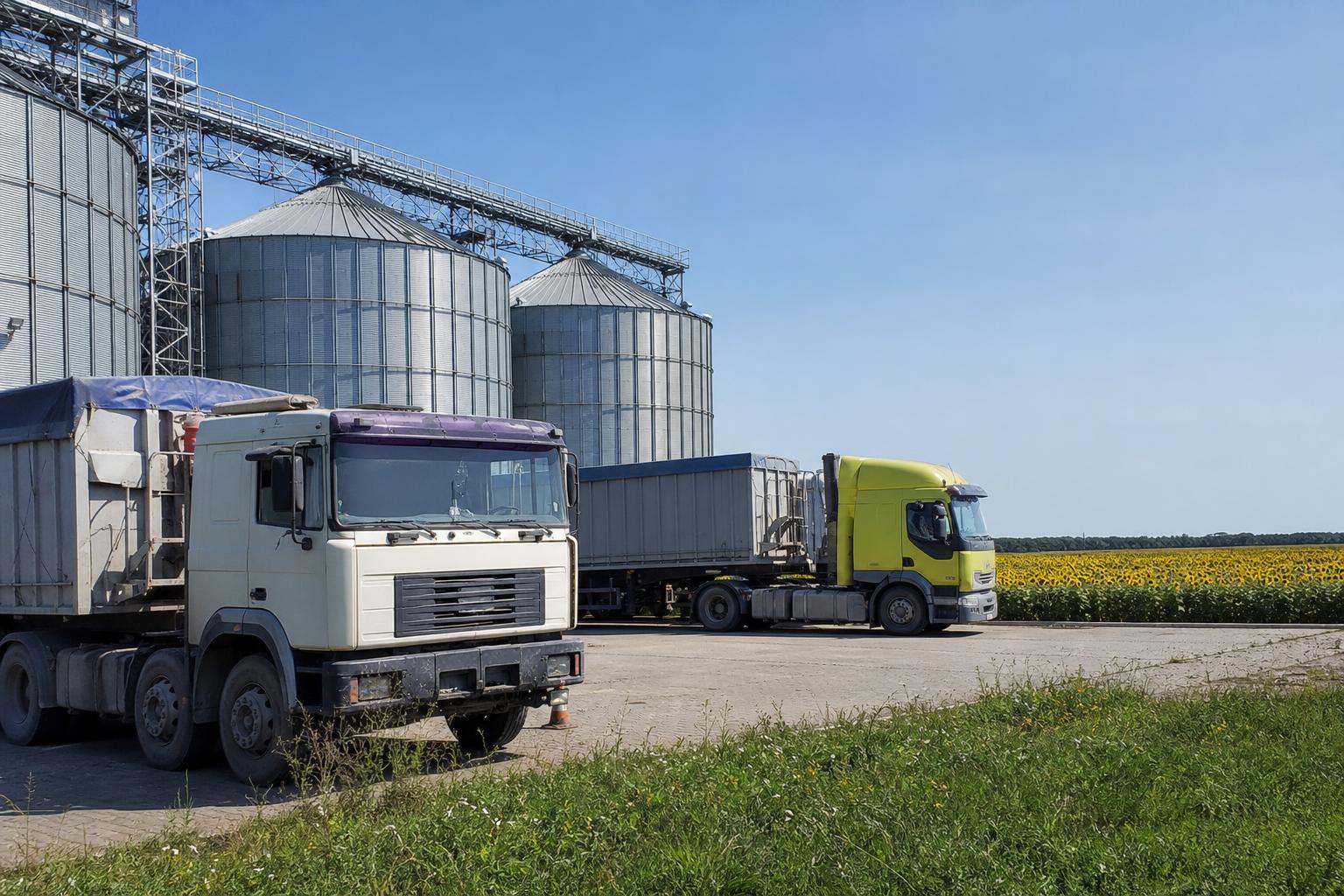
Ukrainian agro-logistics enters October with increased pressure on road and rail transport. The main factors are the sunflower harvest, active export of the new crop to elevators and ports, and rising diesel fuel prices.
For sellers and buyers on AgroPost, this means that the product price increasingly depends not only on demand for the crop but also on the availability of transport in specific regions and over particular distances.
Where the Grain Truck Shortage Is Most Critical
According to analytics by UkrVantazh Agro, the most acute shortage of truck-mounted grain carriers is observed in Dnipropetrovsk, Odesa, and Mykolaiv regions. In these areas, the number of freight vehicles significantly exceeds available transport capacity.
The tense situation is also noted in Kirovohrad, Poltava, Cherkasy, Chernihiv, and Vinnytsia regions. From these areas, large volumes of agricultural products are currently moving to storage, processing, and export logistics hubs.
Particularly notable is the Odesa direction: a significant portion of freight flows are directed there. Active transportation is ongoing from Dnipropetrovsk, Mykolaiv, Cherkasy, Poltava, Kirovohrad, and Kharkiv regions.
Short Routes Are Increasing in Cost the Fastest
The highest rate increases have been recorded on routes up to 300 km. Over a week, such transportation costs rose by 10–12%.
This is logical during the active sunflower harvesting period: short hauls are most often used for prompt delivery of the harvest from the field to elevators, warehouses, or the nearest transshipment points.
On medium and long routes, rates increased more moderately — mainly by 3–6%. No changes were recorded over distances of 601–700 km, while routes over 800 km saw an increase of 3–4%.
An additional factor is diesel fuel. According to market data, average prices for diesel have increased across all Ukrainian regions; notably, in Odesa region — by 1.3%, and in Mykolaiv — by 1.1%.
Railway Sector: Demand Exists, but Wagon Availability Is a Bottleneck
Alongside road logistics, tension persists on railway export routes. According to PUSK estimates, at the western border, demand for Ukrainian rapeseed remains at 460–465 €/t, but sales are constrained by a shortage of available wagons at acceptable prices.
After the complications in the operation of deep-water ports in Europe, the European market has become an important destination for rapeseed, with railways serving as a key export channel. PUSK estimates that in August-October, 60–70% of rapeseed exports could be shipped by rail wagons.
As of October, according to PUSK data, approximately 330,000 tons of rapeseed are contracted. A significant portion of logistics for this volume is also booked, so sharp changes in export rates are not expected at this time.
Considerations for Sellers and Buyers
- Sellers from regions with transport shortages should check vehicle availability in advance and fix rates before finalizing the product price.
- Buyers with self-pickup options should consider that short trips may now be more expensive in percentage terms than longer routes.
- Exporters and traders should separately monitor wagon availability at the western border, especially for oilseed crops.
- Participants in AgroPost transactions are advised to specify the delivery basis, loading region, approximate distance, and type of transport immediately.
Implications for the Market
This means that logistics will remain a key factor in price formation within the agro-sector in October. With high demand for grain trucks and limited wagon availability, participants who quickly confirm transport, transparently calculate delivery costs, and incorporate logistical risks into their commercial proposals will have an advantage.
Comments
No comments yetNo comments yet - be the first.