
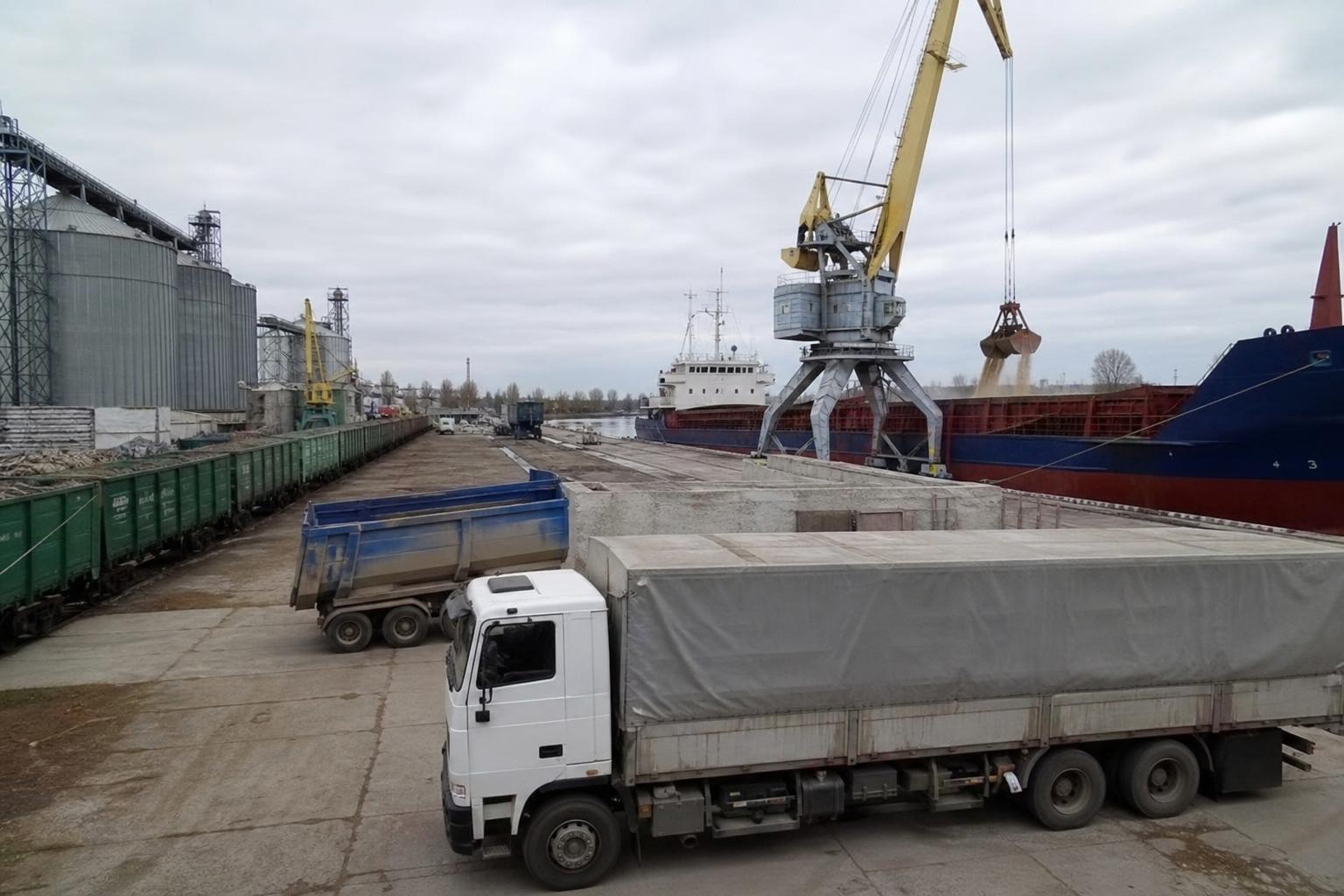
Ukrainian agricultural logistics enters October with several key signals for exporters, traders, and carriers. The Romanian route may gain additional capacity, and the government has announced a mechanism to partially protect shipowners from war-related risks.
At the same time, the market remains sensitive to freight costs and security conditions. This is already evident in the feed barley market: importer demand is weak, and prices at Danube ports have declined even amid stable or higher price levels in some European countries.
Constanța: goal — up to 10 trains per day
Ukraine and Romania have agreed to support the daily transfer of six train pairs to the port of Constanța. The next target is increasing capacity to 10 train pairs per day.
To achieve this, the Romanian side must accelerate repairs of railway and port infrastructure. For Ukrainian exporters, this is important not only as an additional "window" for exports but also as a planning factor: increased regularity of train flows can reduce the risk of wagon accumulation approaching the port.
Separately, the parties are discussing prioritizing the passage of Ukrainian cargo and creating a joint information tool for coordinating carriers and port operators. If such a tool is implemented, businesses will gain greater transparency regarding queues, available slots, and port infrastructure loading.
Danube route: Sulina Canal, Galați, and Brăila
The key issue on the Danube route remains the operation of the Sulina Canal. The Ukrainian side expects a minimum of 10 ships entering and 10 ships leaving daily.
The participation of the Ukrainian Sea Ports Authority in joint vessel dispatching is also under discussion. In case of significant vessel accumulation at Ukrainian ports, Romania may allocate a specific day for ships to pass through the Sulina Canal under a special regime.
An additional agreement covers the possibility of night transits for ships that enter the canal before dark, provided safety requirements are met. This is especially relevant during the shorter daylight period, when each hour of canal operation impacts the overall route capacity.
Another area of negotiation is the expanded use of Galați and Brăila ports for Ukrainian cargo. This could serve as an additional diversification option for the market, although the practical effect will depend on available infrastructure, tariffs, and cargo clearance speed.
Maritime risks and support for shipowners
The government announced a decision to compensate shipowners up to 80% of damages in case of vessel damage due to war actions, if such risk is not covered by insurance. This is an important signal for agrarian logistics, as insurance and security risks directly influence shipowners’ willingness to operate with Ukrainian ports.
Potentially, this mechanism could support fleet participation in Ukrainian routes. At the same time, it is critical for businesses to see practical conditions: procedures for confirming damages, covered risks, compensation timelines, and document requirements.
Barley prices reflect logistics impact on sales
The situation with feed barley demonstrates that logistics is now not only a delivery issue but also a pricing factor. According to analysts, Ukrainian feed barley exports are almost nonexistent, and importer demand is episodic.
As of October 7, purchase prices for feed barley at Ukrainian Danube ports decreased by an average of $2/ton — to $140–148/ton CPT port. In hryvnias, the predominant range was 6,600–7,600 UAH/ton CPT port, on average $200/ton lower than at the end of the previous week.
The market is pressured by weak external demand, expectations of supplies from the Southern Hemisphere, security risks on Ukrainian routes, and the situation in the Middle East. All these factors support high shipping risk premiums and freight costs.
Key market participants’ conclusions
- Exporters should include a time buffer in contracts for rail and Danube routes until capacity expansion becomes a stable practice.
- Carriers should monitor developments at Constanța, Sulina Canal, Galați, and Brăila: these directions may create new demand points for wagons, road transport, and transshipment.
- Grain sellers should compare not only the base price but also the full logistics model: freight, queues, port costs, downtime risks, and payment terms.
- Buyers and traders should promptly communicate available routes and cargo acceptance conditions, as quick contract execution becomes a competitive advantage amid weak demand.
Implications for the market. The expansion of the Romanian route may partially ease logistical pressure on Ukrainian agrarian exports, but a rapid cost reduction is unlikely. The main practical takeaway for AgroPost participants is that selling and buying agricultural products should be based on clear calculations of routes, current freight costs, and risks of delays on rail, Danube, and in ports.
Comments
No comments yetNo comments yet - be the first.