
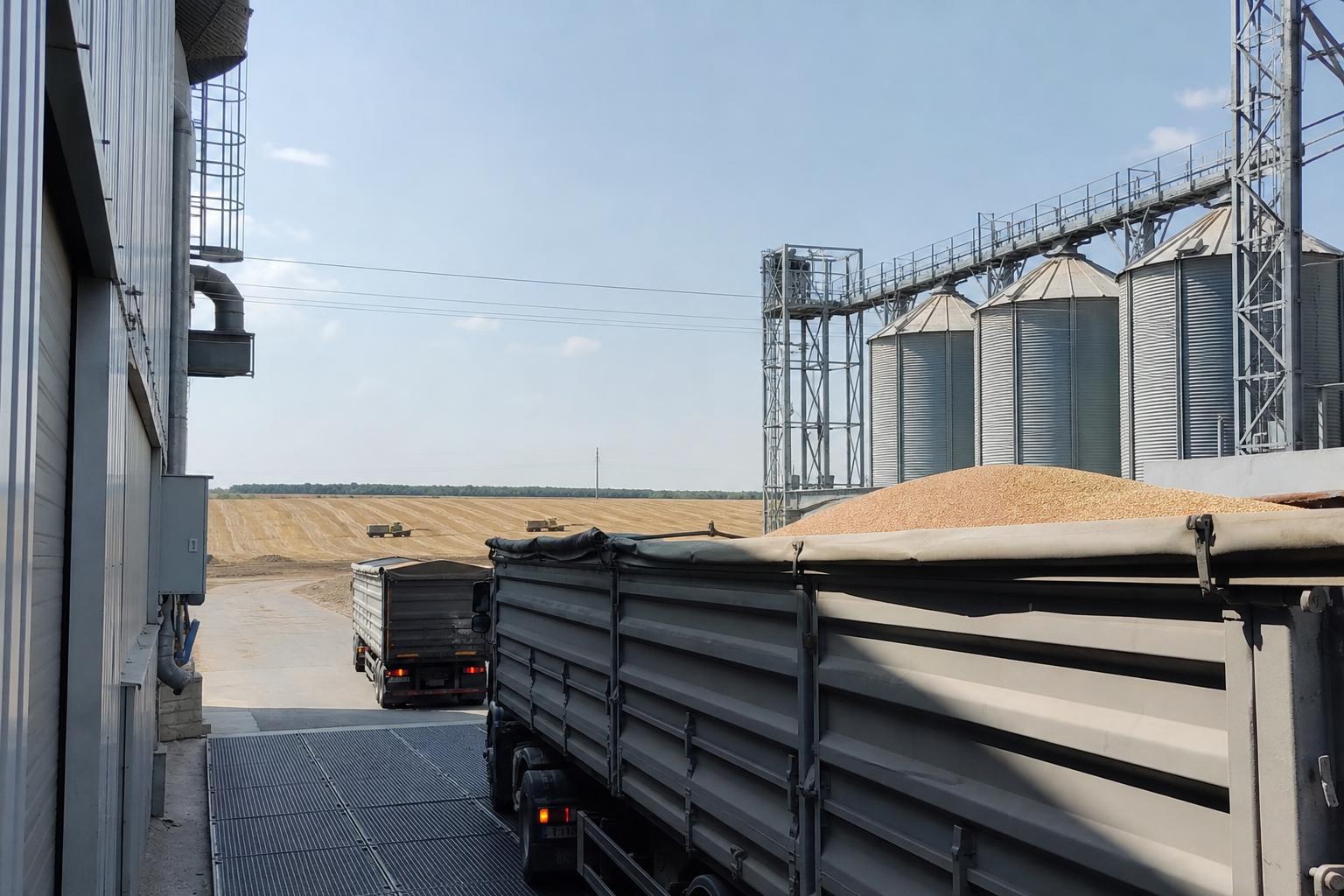
The Ukrainian grain market is entering a period where physical availability of grain is no longer the main issue. The primary challenge for sellers and traders is how quickly and cost-effectively to export batches amid expensive alternative routes.
According to data announced by the Ministry of Agrarian Policy, from August 1 to 18, Ukraine exported 900,000 tons of agricultural products. Grain accounted for 522,000 tons, which is only about 20% of the potential volume under free logistics through the Black Sea ports.
Grain export: bottleneck — not demand, but route
The largest decline in exports is observed in grains. The reason is the high sensitivity of wheat, corn, and other staple crops to transportation costs.
When logistics become more expensive, grain quickly loses margin compared to higher value-added products. For producers, this means that the price on FOB terms, transportation to the elevator, or the buyer’s willingness to bear logistical costs become critical conditions of the deal.
- For sellers: it is advisable to separately calculate the price at the farm, at the elevator, and with delivery to the border or port.
- For buyers: offers with clearly fixed shipment conditions and understandable grain quality may be advantageous.
- For elevators: demand for prompt acceptance, processing, and short-term storage may remain high in regions with active harvesting.
New wheat harvest already shaping supply
On the domestic market, the supply of new harvest grain is increasing. As of August 17, early cereals and legumes had been harvested from 6.59 million hectares, or 56% of the forecasted areas. The yield reached 30.84 million tons with an average yield of 4.6 t/ha.
Some producers are already reporting the completion of early crop harvests. For example, "Astarta" harvested early crops from 54,000 hectares and obtained about 256,000 tons of yield, of which over 210,000 tons were wheat.
The average yield of winter wheat in the company was 5.4 t/ha. The highest result among its farms was demonstrated by "Khmilnytske" in Vinnytsia region — 7.7 t/ha of winter wheat.
Elevators and logistics: which parameters of the deal are becoming more important
In the current situation, grain of the same quality can have different actual prices depending on storage location, access to railcars or trucks, and the speed of document processing.
For AgroPost sellers, this means that the announcement should clearly specify the crop, volume, sale basis, storage location, loading possibilities, and quality indicators. Such details reduce negotiation time and help buyers quickly assess the actual economics of the batch.
Grain buyers should compare not only the declared price per ton but also the full delivery cost to the required destination. During periods of unstable logistics, these costs can determine whether the deal will be profitable.
Dniester direction: regional infrastructure continues to develop
In Romania, the modernization and expansion of the Luminița port on the Danube-Black Sea canal has been completed. The project cost was 120 million lei, approximately €24 million including VAT.
The port facility received berths and infrastructure for water and electricity supply. The goal is to reach a throughput of 300,000 tons of cargo per year by the third year of operation. Before full operation begins, administrative procedures are to be finalized, and port areas will be auctioned.
For the Ukrainian grain market, this is not an immediate solution to logistical issues, but infrastructure development along the Danube-Black Sea route is worth monitoring for all participants working with export batches.
What this means for the market: the new harvest grain is entering the market more actively, but export logistics remain the main constraint. Sellers should make proposals as transparent as possible regarding quality and shipment location, while buyers should calculate the full logistical cost of the deal, not just the price per ton.
Comments
No comments yetNo comments yet - be the first.