
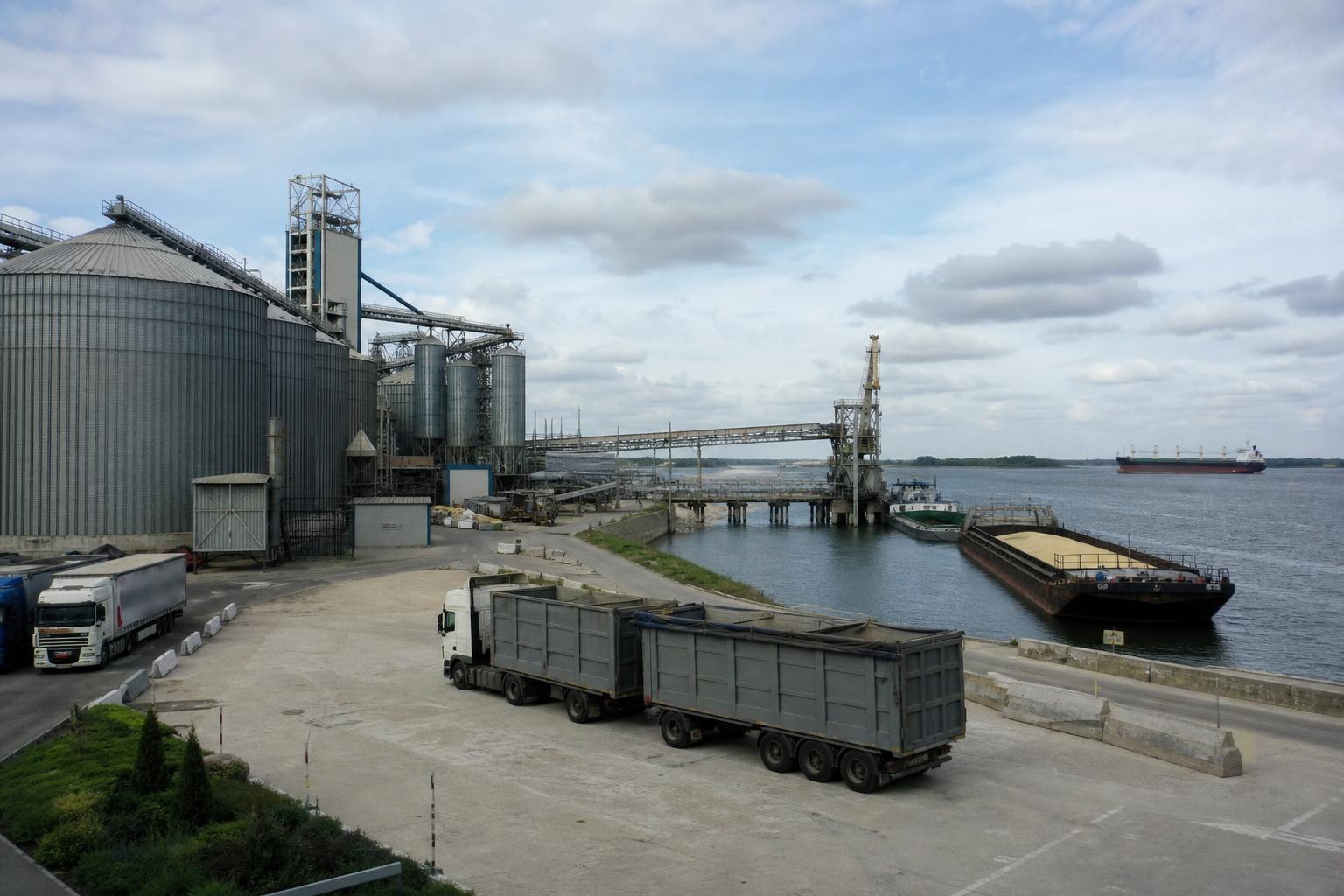
Ukrainian agricultural logistics enters the second half of the year with two parallel signals: seaports are increasing cargo throughput, but security risks remain a key factor for exporters, traders, and carriers.
For grain sellers, oilseed producers, fertilizer suppliers, and transportation providers, this means the need for more careful planning of routes, delivery conditions, and the availability of fleet, wagons, and road transport.
Ports remain the main channel for agro-export
According to the Ukrainian Sea Ports Authority, in the first half of 2026, Ukrainian seaports handled 42.4 million tons of cargo. Of this, 23.6 million tons were agricultural products.
Compared to the same period last year, the handling of agricultural cargo increased by 20%. This confirms that the agro-sector continues to constitute a significant part of port freight flows.
This is an important benchmark for the market: demand for services from port operators, freight forwarders, road carriers, rail delivery to ports, and warehouse capacities near export hubs remains high.
Security factors influence supply planning
Despite the growth in throughput, port infrastructure remains under constant threat of attacks. According to the Ukrainian Sea Ports Authority, since the full-scale invasion, 1,002 port infrastructure objects have been damaged or partially destroyed, and 221 civilian vessels have been damaged.
In July, attack intensity increased: in the first two weeks of the month, 23 strikes on Ukrainian ports and 17 attacks on civilian vessels were recorded. Such conditions compel market participants to incorporate contingency plans into logistics strategies.
For agro-product sellers, this means that the price under port delivery terms can fluctuate rapidly depending on terminal availability, queues, insurance conditions, and buyers’ risk acceptance.
Danube route gains additional significance
Against the backdrop of strained maritime logistics, Ukrainian companies are increasingly working with river routes. "NIBULON" has signed a long-term contract with Romanian TTS for international transportation along the Lower Danube between Romania, Serbia, and Bulgaria.
Under the terms of the agreement, over four months, barge-tug convoys will operate international routes between these countries. The first voyage has already taken place: fertilizers were delivered from Constanța to Prahovo, and the return trip involved grain and oilseed loading in Bulgarian Danube ports with delivery to Constanța.
A key logistical advantage of this format is the circular movement scheme. It reduces empty runs and allows for more efficient fleet utilization. One barge-tug convoy can carry approximately 8,000 tons of cargo.
What sellers and buyers should consider
- Verify routes before concluding agreements. For grain, oilseeds, and fertilizers, it is crucial to clarify in advance whether there is confirmed access to the port, terminal, or river transshipment point.
- Fix logistics conditions in announcements. On AgroPost, it is advisable to specify the delivery basis, transport availability, preferred shipment direction, and approximate quantities.
- Compare maritime, Danube, rail, and road channels. During unstable situations, the participants with multiple options for delivery gain an advantage.
- Allow time for cargo rerouting. Risks of delays or route changes can impact the final margin of the deal.
Implications for the market: Ukraine’s agricultural logistics remains active but increasingly depends on route flexibility. Seaports continue to play a leading role in exports, while the Danube and international river transport are becoming vital tools for contingency planning and supply optimization.
Comments
No comments yetNo comments yet - be the first.